
Night owls: Seeing justice systems in new light
By Gemma Buckland
Picture an owl gliding through the night, eyes wide, attuned to the slightest movements in a landscape we would call darkness. Its gift is its perspective – an ability to take a wide view while perceiving fine-grained detail, to zoom out and zoom in and expertly capture what it needs to sustain itself.
In Justice Futures’ recent work with Koestler Arts and The Human Centre, inspired by the title of the former’s exhibition at the Royal Festival Hall, we adopted the owl as a playful companion for reflecting on the arts on display and imagining justice futures with both heart and head. The owl’s eye became a format for our subsequent collective dialogue.
We have since been reflecting on the wider representation of the owl and its characteristics and caricatures for Justice Futures’ practices. With panoramic awareness, night vision and remarkable depth perception, the owl helps us bring to life some core aims of systems approaches: to see the bigger picture, to super-sense the small shifts that signal change in our eco-systems, and to tune into what matters.
Owls also carry rich symbolism – associated with knowledge in Hindu traditions, with wisdom, vision, and protection in Roman mythology and as messengers in modern fiction – inviting us to lean into our senses and find new information and intelligence as we re‑examine our assumptions about justice.
Why owls?
Owls have fixed vision but can rotate their heads either side and almost upside-down to take in a near‑360° view. With the ability to see objects with 5% of the light that humans need, an owl’s night vision is finely tuned to subtle patterns in our surroundings that we would miss. They thrive in darkness by seeing what others cannot.
In complex systems – like criminal, civil and social justice, and the intersections between them – many dynamics that might influence change stay hidden in shadows, with the route to resolving them often also obscured. Yet, they are detectable if we choose purposefully and patiently to focus our attention on them, like the owl which thrives in the quiet as it silently flaps its wings.
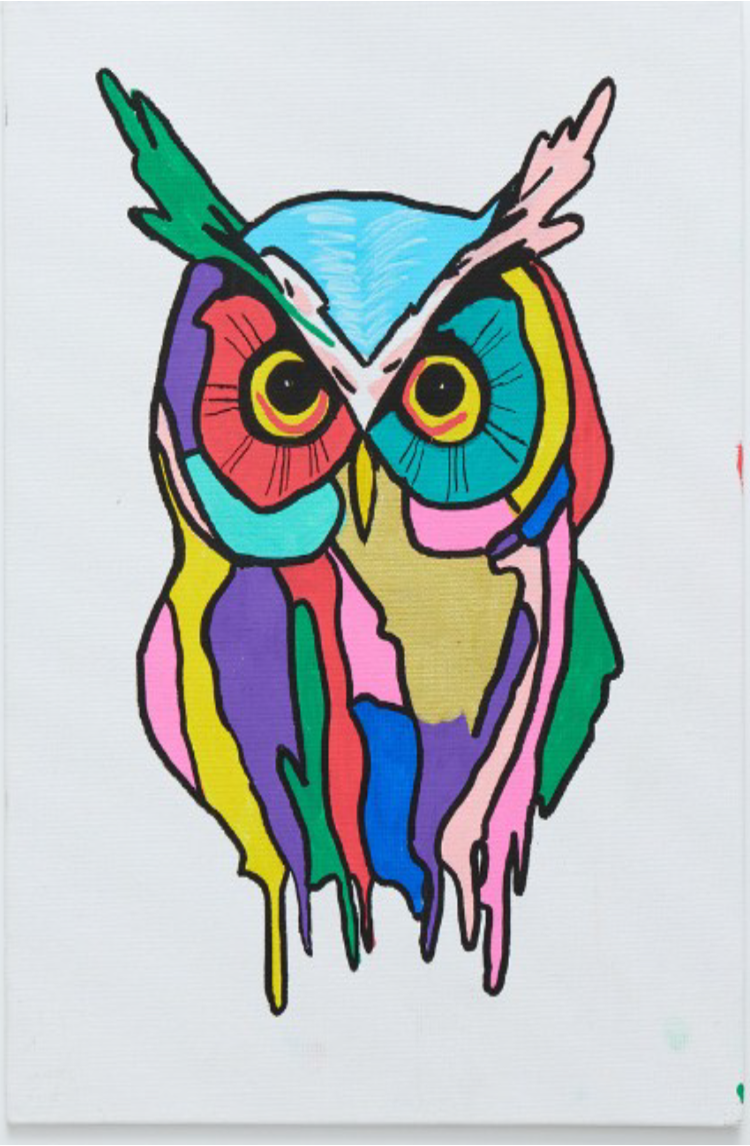
Image credit: Koestler Arts exhibit, 2025
The owl’s three gifts for systems change
1) Wide‑angle vision: holding the whole
From their elevated positions, perched on a branch or soaring high in the sky, and with their holistic vision, owls see the world with a wide-angled lens. They also swallow things in their entirety and rather than breaking them down into parts, they digest the whole into a single pellet that melds all the components together.
Justice Futures’ practices help people to zoom out and view justice systems with new eyes, to see the systems dynamics and see themselves within them. We encourage people to step back and take a fresh look at the roles they and others play in justice ecosystems, exploring multiple viewpoints rather than in isolated parts, and integrating the wisdom of the whole (all of us) to widen our possibilities for change.
2) Depth perception: seeing the hidden
Even in darkness, an owl detects subtle movement in the undergrowth which makes them alert to signals for where to navigate next in places and spaces which allow the, to perceive what most creatures cannot. Our creative practices dig deep into these subtleties too, encouraging curiosity about the systemic dynamics at play, revealing unseen blockers to progress, and uncovering new insights and actions for change.
3) Attunement: listening across difference
Owls are silent hunters – deeply attuned to the living world, continually integrating environmental feedback into their daily survival activities. They also have exceptional hearing using not only their ears but also their faces which act as a conduit, funnelling and amplifying sound. After feeding, they spend lots of time resting and slowly digesting.
We strive for the same quiet curiosity, finding peace and stillness to reflect, adapt and act, tuning out the surface noise and urgency of fixing broken systems. In doing so, our practices focus on suspending judgement and listening deeply to the things that really count, finding wisdom in different perspectives.
From insight to action
Seeing wholes, thinking deeply, and listening across difference must translate into practice. Our starting point is how we do change rather than what change we do. Justice Futures supports people seeking transformative change to generate and test ideas for change, form wider movements, and measure and evaluate ongoing impacts so that learning and adapting becomes part of the system, not an afterthought.
Our invitation
Justice Futures exists to cultivate your curiosity, build your capacity to see systems more clearly, and gain confidence and connections to act more wisely today toward the justice systems of tomorrow. Let’s learn to see like owls and take a fresh perspective on what possibilities there might be for building just futures together.